

Should you go to A&E, your GP, or an optician with a sudden eye problem?
For many sudden, recent eye problems, an optician is the right first call rather than A&E or your GP. Both our Conisbrough and Staveley practices offer NHS-funded appointments for recently occurring eye conditions, there is no charge for the appointment, and you do not need a referral from anyone to use it. Simply telephone the practice and we will ask you some questions about what is going on.
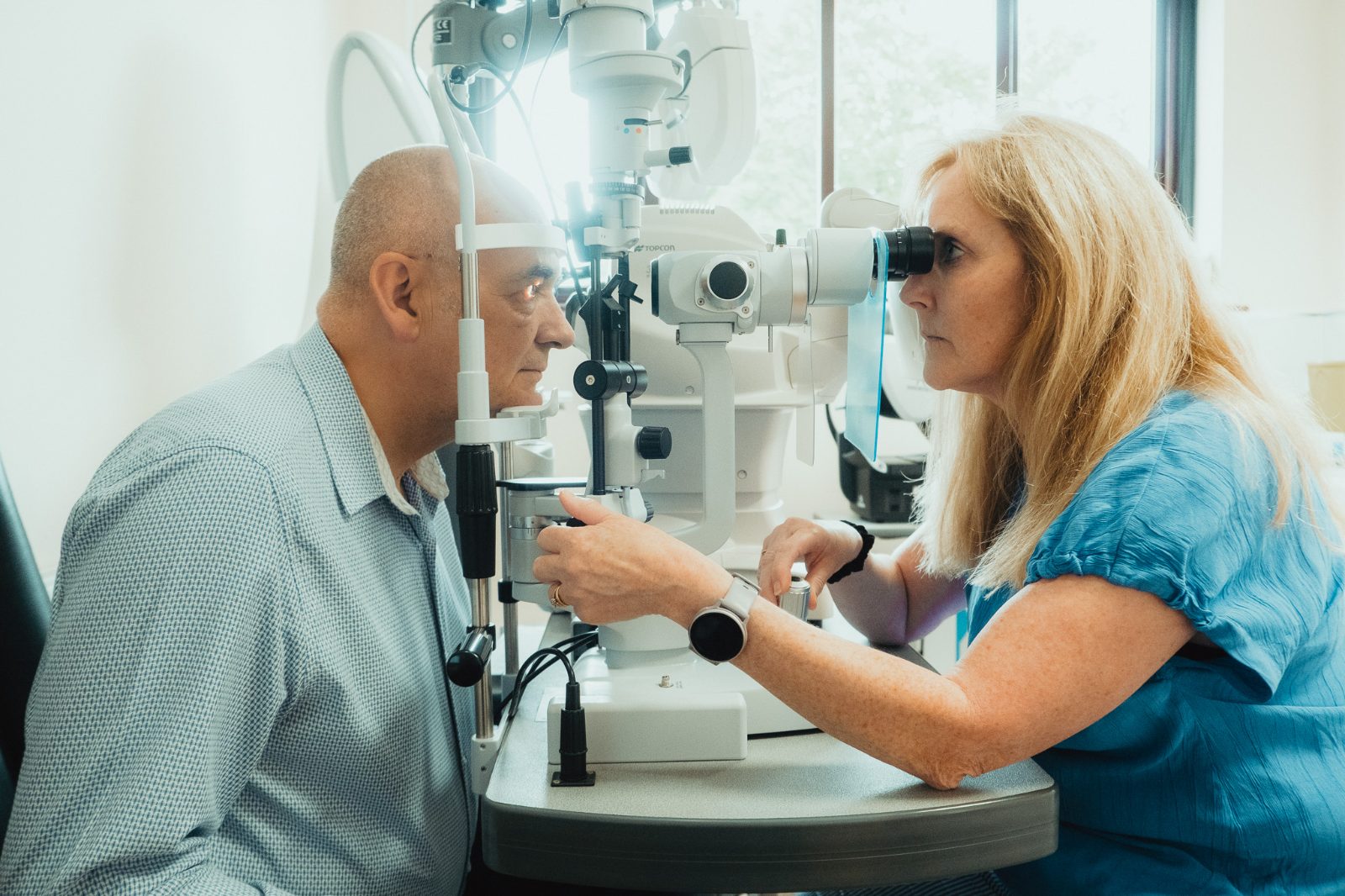
This is not the same thing as an eye test, and it is not us squeezing you into a sight test slot. It is a separate NHS service, commissioned locally, designed to take pressure off GP surgeries and hospital eye clinics by having eye problems looked at by people who already look at eyes all day. Optometrists have the equipment and the training to examine the front and the back of your eye in detail.
The catch, and the reason so few people know about it, is that these schemes are commissioned area by area rather than nationally. That means the name of the service, who qualifies, and which practices are accredited to deliver it all vary depending on where your GP is registered. Our two practices sit in two different areas, and they run under two different schemes with two different names, so there is a section for each branch further down.
What sort of eye problems can be seen at an urgent appointment?
The service is for problems that have come on recently and suddenly. That covers a red, sore, itchy or painful eye, the sensation that something is in your eye, sticky discharge, swollen or irritated eyelids, ingrowing lashes, new flashes or floaters in your vision, and sudden blurring or distortion of your sight.
That last group is the one people most often sit on. New flashes of light or a shower of floaters can be nothing at all, and can also be the first sign of a problem with the retina that is far easier to deal with early than late. If your vision changes suddenly, do not wait to see whether it settles on its own. Ring us.
What is not covered by the urgent eye service?
Long-standing problems are not covered, and neither are conditions you are already being monitored for. If you have glaucoma, cataracts or diabetic eye disease under regular review with us or with the hospital, that continues through your usual appointments rather than this route. Headaches without any visual symptoms belong with your GP. If you wear contact lenses and have a problem related to them, you should normally contact whoever supplies your lenses first, unless any of the emergency signs in the next section apply to you.
The service also does not replace a sight test. If what you need is a change of prescription, we will tell you that and book you in properly rather than sending you away with nothing.
When is an eye problem an emergency rather than an urgent appointment?
Some things should not wait for a phone call to us at all. Go straight to A&E, or call 999, if you have had a serious injury to the eye, particularly a penetrating injury or a heavy blow. Do the same for a chemical splash, and rinse the eye thoroughly with clean water on the way.
Also treat it as an emergency if you have severe pain in or around the eye, especially alongside headache, nausea, reduced vision or real sensitivity to light. The same applies if you have sudden loss of vision, if you wear contact lenses and have a red, painful eye with reduced vision, if you have a painful eye together with a drooping eyelid, double vision or a pupil that looks different from the other one, or if you have severe pain or loss of vision after recent eye surgery or an injection.
If you are unsure which category you are in, NHS 111 will help you decide, and both of our practices are on the approved list that 111 refers people to.
How do you get an urgent eye appointment at our Conisbrough practice?
Telephone the Conisbrough practice on 01709 862885 and tell whoever answers that you have a recent eye problem rather than that you want an eye test. In our area the scheme is called the Minor Eye Conditions Service, usually shortened to MECS, and is available to those registered with a Doncaster GP. We will ask you a short set of questions about your symptoms to work out how quickly you need to be seen, and we will book you in accordingly.
This is not a walk-in service, so please ring before you set off rather than turning up. We need to hear what is going on before we can judge how quickly you need to be seen.
Aileen and Phil Murgatroyd test here throughout the week and both hold independent prescriber status, which matters for these appointments in particular, and there is more on why in a moment.
The practice is at The Old Surgery on March Street, in the building older residents will remember as the doctor's surgery.
How do you get an urgent eye appointment at our Staveley practice?
Telephone the Staveley practice on 01246 477199. We trade there as Murgatroyd Holmes Opticians, at 33 High Street, so that is the name on the door and on the sign, and it is the same practice and the same family business.
Staveley falls under Derbyshire, which runs its scheme as the Community Urgent Eyecare Service, usually shortened to CUES. It covers the same sorts of problems as the Conisbrough service, under a different name. The important practical difference is the eligibility rule, because CUES is for patients registered with a Derby city or Derbyshire GP. If you live near the county boundary, which plenty of our patients do, what counts is where your GP surgery is, not where your house is. If you are not sure which of our two practices you should be ringing, ring either and we will work it out with you rather than leaving you to guess.
Why does it matter that both of our optometrists are independent prescribers?
It changes how often an urgent appointment ends with the problem dealt with rather than passed on. Independent prescriber is a further qualification on top of optometry, and both Phil and Aileen hold it. It means we can prescribe medicines for conditions of the eye, including treatments that are not available over the counter, rather than examining you, reaching a conclusion and then having to send you elsewhere to actually get treated. Not every optometrist holds this qualification.
A cyst in the eyelid, a chalazion, is the clearest example of the difference. The usual route is a heat bag and patience, and if it has still not cleared after around six months you may then qualify to be referred to hospital to have it removed. Because we can prescribe, we can often start a course of treatment straight away instead. It still takes a while to clear, sometimes a month or two, but the path to getting there is a great deal shorter than half a year of warm compresses.
There is one part of this we would rather be straight about than let you discover at the counter. There is no funded NHS prescribing route for optometrists in our areas, so we do not hold an NHS prescription pad. In practice that means we either write you a private prescription to take to a pharmacy, which you pay for, or we write to your GP asking them to issue it while we continue to manage the condition. We will explain which applies to you at the appointment.
What actually happens at an urgent eye appointment?
It starts on the phone, with the triage questions, because the answers determine how urgently we need to see you. When you come in, bring your glasses if you wear them and a list of any medication you take.
The examination itself is a proper look at the eye rather than a glance. We may need to put drops in to enlarge your pupils so we can see further inside, and if we do, you should not drive until they have worn off, which can take a few hours. Arrange a lift before you come if that is likely.
You will leave with one of a handful of outcomes. We may treat or prescribe. We may advise you on managing it yourself, which for plenty of these problems is the honest answer. We may refer you into the hospital eye service, urgently or routinely depending on what we find. We may tell you it is related to your general health and point you back to your GP. Or we may recommend a sight test, if it turns out the problem is your prescription.
Why have most people never heard of this?
Mostly because nobody has told them. There has been no national campaign, the scheme has a different name depending on which side of a county boundary you live, and accreditation varies from practice to practice, so there is no single message anyone can put out. The result is a free NHS service that most of the people who could use it have never been told about.
If you take one thing from this, make it the phone number. Both of our practices are on the approved list, both of our optometrists can prescribe, and it costs you nothing to ring and describe what is happening.
Common questions about urgent eye appointments
Do I have to be an existing patient to be seen?
No. The NHS urgent eye services are open to anyone who meets the eligibility rules for the area, not only to registered patients of the practice. If you have never been to us before, ring and say so.
Does it cost anything?
The appointment itself is free to eligible patients, funded by the NHS locally rather than by you. If you end up needing medication, the cost of that follows the usual rules for prescription charges.
Do I need my GP to refer me?
No. You can ring the practice directly and refer yourself. GPs, pharmacists and NHS 111 can also point people towards the service, but you do not need to go through any of them first.
Is this the same as an eye test?
No. A sight test is a routine check of your vision and eye health, usually on a two-yearly recall. This is a separate appointment about a specific problem that has come on recently. If you need both, we will sort both out, but they are not the same appointment.
What is the difference between MECS and CUES?
Very little, from your point of view. They are the same kind of NHS service run by two different areas under two different names. Conisbrough operates under MECS and Staveley under CUES. Which one applies to you depends on where your GP is registered, not on which of our practices is nearer.
How quickly will I be seen?
That depends on your symptoms and on how the diary looks that week. Genuinely urgent cases are prioritised, which is why the triage questions on the phone matter. Ring us at Conisbrough or Staveley and we will tell you honestly when we can see you rather than making you guess.
What if my eye problem happens on a Sunday or in the evening?
We are closed, so use NHS 111, which can direct you to the right place including out-of-hours eye services. If it meets any of the emergency descriptions further up this page, go to A&E.
If something has changed with your eyes and you are not sure what to do about it, ring Conisbrough on 01709 862885 or Staveley on 01246 477199 and describe it to us. You can also find both branches, our opening hours and the full range of eye care services we offer on the Murgatroyd Opticians website.
Ring us about a sudden eye problem
Do not wait to see whether it settles on its own. Ring the practice and describe what is happening.
Conisbrough 01709 862885 · Staveley 01246 477199